
How We Teach & Learn at Norbury Manor
Our Curriculum Philosophy – Depth to Enable Breadth
At Norbury Manor Primary School, our curriculum is designed to meet the requirements of the Early Years Foundation Stage and National Curriculum, while reflecting the needs, interests and experiences of the children in our school community.
Our curriculum is characterised by our belief in:
“Depth to Enable Breadth”
We believe that children need secure foundations of knowledge, skills, vocabulary and understanding so that they can make connections, think deeply and confidently explore the wider curriculum.
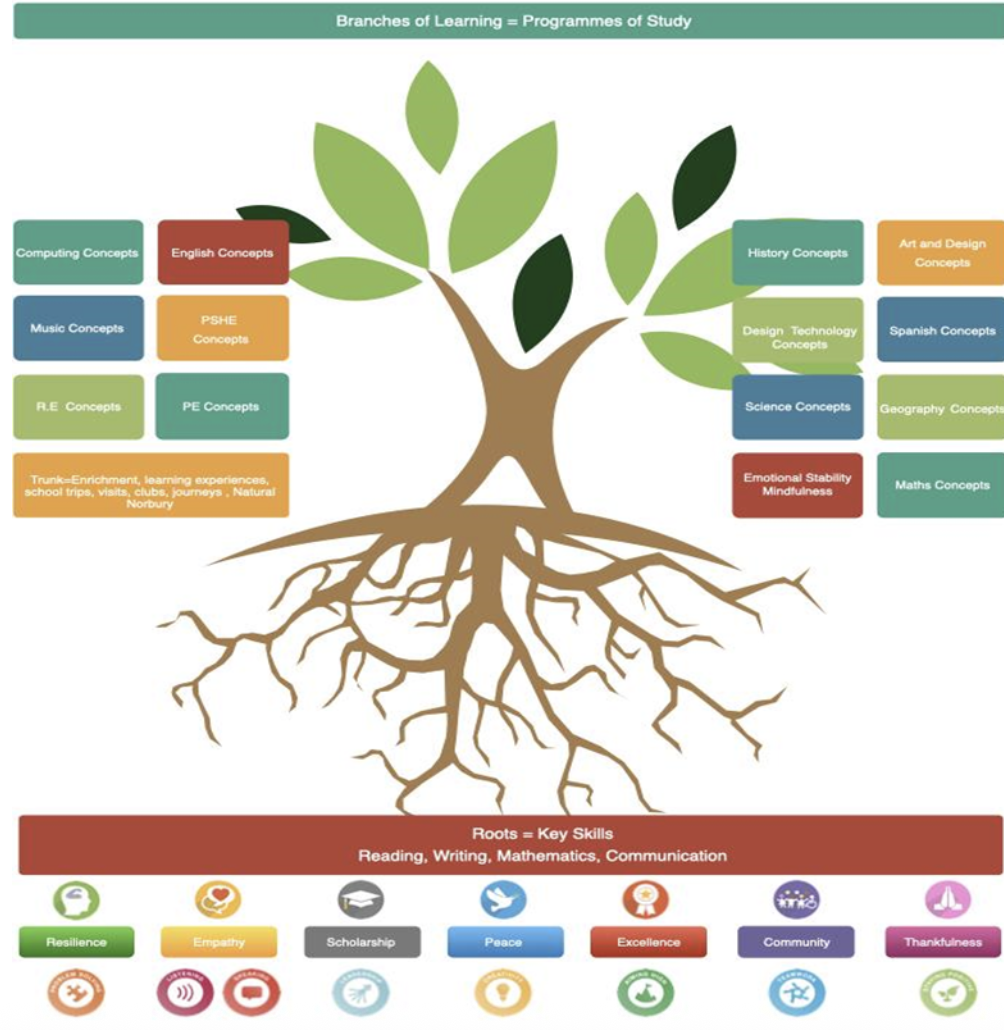
Our curriculum tree represents this journey.
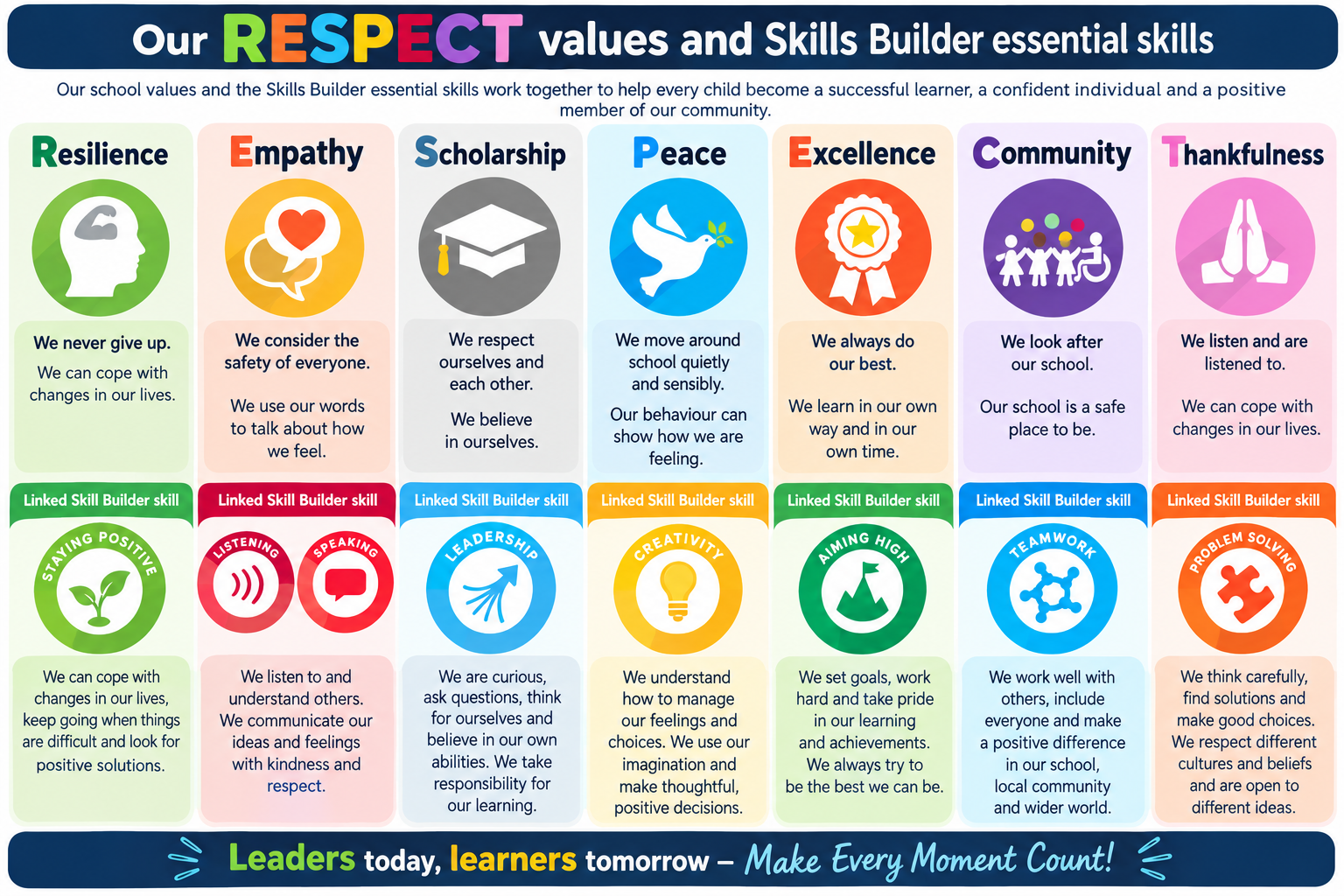
The roots represent the essential knowledge, skills and values that give our children strong foundations. They include our RESPECT values and Skills Builder essential skills, which help children develop as learners and as people.
The trunk represents the strength of character, experiences and relationships that develop as children progress through school.
The branches and leaves represent the knowledge, concepts, ideas and interests that continue to grow. As children learn more, they make new connections, ask increasingly challenging questions, develop their own opinions and sometimes reconsider what they previously thought.
Just like a tree, learning never really stops growing.
Our ambition is for every child to leave Norbury Manor with strong foundations and the confidence, curiosity and skills to continue learning throughout their lives.
How We Teach – I Do, We Do, You Do
At Norbury Manor, we use the I Do, We Do, You Do model to support children as they move from learning something new towards being able to apply it independently.
The model is based on a gradual release of responsibility. Teachers explicitly teach and model new knowledge and skills before children practise with support and, when they are ready, apply their learning independently.
I Do – Teacher Modelling
The teacher introduces new learning and makes their thinking visible.
Teachers may explain, demonstrate, model, think aloud and use worked examples so that children can see not only what to do, but how and why.
Depending on the subject and concept being taught, teachers may use concrete resources, images, diagrams, examples, demonstrations and carefully selected vocabulary.
We Do – Guided Practice
Children then practise the new learning with the teacher and with each other.
Teachers use questioning, discussion, worked examples and guided practice to check understanding, address misconceptions and provide further explanation or modelling where needed.
This stage gives children the opportunity to rehearse their thinking, explain their ideas and develop confidence before working independently.
You Do – Independent Application
When children are ready, they apply their learning with increasing independence.
Independent practice helps children to remember, retrieve and apply what they have learned and gives teachers valuable information about how securely pupils understand the knowledge or skill being taught.
Responsive Teaching
Learning is not a race from I Do to You Do.
Teachers continually check children's understanding and adapt their teaching in response. Some children may be ready to work independently quickly, while others may benefit from further modelling, examples, scaffolding or guided practice.
Our aim is to provide high expectations alongside the right support, enabling every child to make progress towards increasingly independent learning. This complements the current national emphasis on high-quality adaptive teaching and inclusive provision.
Developing Deeper Thinking – Bloom's Taxonomy
Learning is about much more than remembering facts. Children also need opportunities to understand, apply, analyse, evaluate and create.
We use Bloom's Taxonomy as one of the tools that helps teachers think about the level of challenge within learning.
Children might begin by recalling important knowledge and demonstrating their understanding before using that knowledge in increasingly challenging ways.
As their knowledge becomes more secure, children are encouraged to:
Remember → Understand → Apply → Analyse → Evaluate → Create
This could mean explaining why something happened in history, comparing different solutions to a mathematical problem, evaluating evidence in science or using knowledge and skills from several lessons to create something entirely new.
The aim is not simply to make work harder. It is to help children think more deeply about what they know.
Making Connections Through Themes
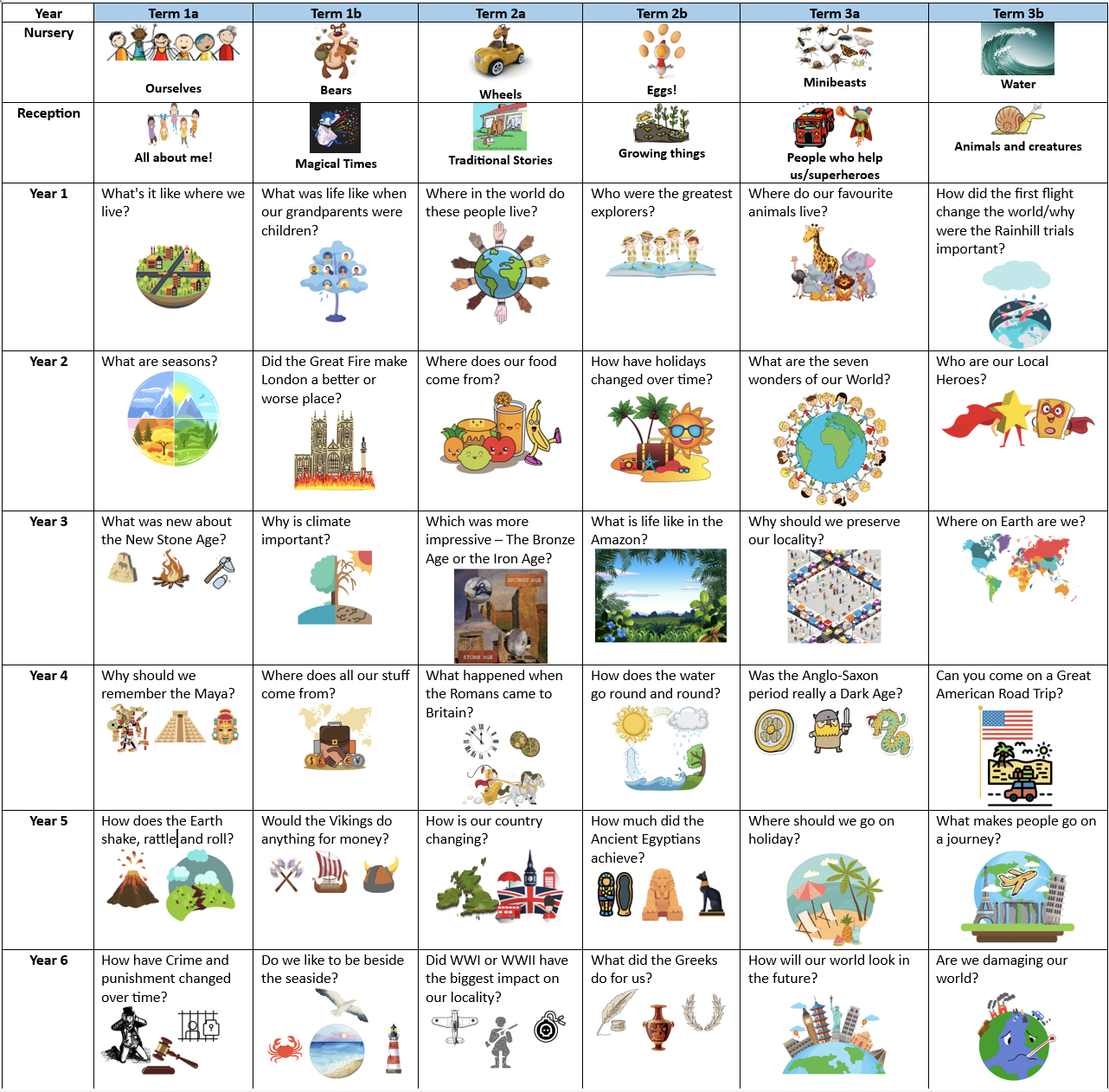
Our school year is organised around themes that provide opportunities for children to make meaningful connections across their learning.
Where connections between subjects genuinely strengthen children's understanding, teachers use them to help children see how knowledge fits together.
For example, a text studied in English might complement the historical period children are studying, allowing them to encounter related vocabulary, ideas and concepts in different contexts.
However, we recognise that every subject has its own important knowledge, vocabulary and ways of thinking. Connections are therefore made purposefully rather than simply because subjects happen to be taught at the same time.
Our themes provide a context for learning while ensuring that the integrity of individual curriculum subjects is maintained.
An Inclusive Curriculum – Success for Every Learner
We have high expectations for every child.
Our children have different starting points, strengths, experiences and needs. Our approach is therefore not about expecting every child to learn in exactly the same way or at exactly the same pace.
Teachers identify potential barriers to learning and use adaptive teaching to help children access our ambitious curriculum. This may include carefully chosen scaffolds, additional modelling, adapted resources, visual support, pre-teaching, opportunities for rehearsal, assistive technology or additional adult support.
This is particularly important within our diverse school community, including pupils with SEND, children who speak English as an additional language and pupils who may need additional support at different points in their education.
Where children access additional or specialist provision, our aim is to maintain their connection with the wider curriculum and school community wherever appropriate.
Challenge Week – Putting Learning into Action
At the end of each term, children take part in Challenge Week.
Challenge Week provides an opportunity for pupils to bring together knowledge and skills developed during the term and use them to respond to an age-appropriate challenge or project.
Children may work independently, in pairs or as part of a team, depending on the challenge. They are encouraged to plan, make decisions, solve problems, create, communicate and reflect.
Projects may result in a wide range of outcomes, including:
- exhibitions and displays
- presentations and assemblies
- videos and photography
- artwork and practical creations
- written work
- performances
- enterprise activities.
Children are given opportunities to present their work to an audience and reflect on both the outcome and the process: What did they learn? What went well? What challenged them? What would they do differently next time?
Challenge Week is also an important opportunity for children to put our RESPECT values and Skills Builder essential skills into action.
RESPECT Values & Essential Skills
Academic knowledge is only one part of preparing children for their future.
Alongside our curriculum, we explicitly develop children's character and essential skills through our RESPECT valuesand the Skills Builder Universal Framework.
Our eight essential skills are:
Listening | Speaking | Problem Solving | Creativity | Staying Positive | Aiming High | Leadership | Teamwork
Rather than treating these skills as something separate from learning, we provide opportunities for children to practise and develop them across lessons, Challenge Week, assemblies, leadership opportunities, enrichment and wider school life.
Children work through age-appropriate Skills Builder steps and are supported to understand what improving a skill actually looks like.
At Norbury Manor, we have also developed our own inclusive Mild, Spicy and Hot approach to help children access and demonstrate the steps at an appropriate level of challenge.
Our Skills Builder work is closely connected to our RESPECT values, helping children understand not only what skills they are developing but how those skills can help them become successful learners, leaders and members of their community.
Learning Beyond the Classroom
We believe that some of the most memorable learning happens when children have opportunities to experience, explore and apply what they have learned.
Trips, visitors, workshops and practical experiences are carefully chosen to complement our curriculum and deepen children's understanding. These experiences help children to make connections between classroom learning and the wider world.
For example, children may take part in a chocolate workshop linked to the topic they are studying, visit places connected to their history or geography learning, work with specialist visitors, take part in performances or experience learning within the local community.
These opportunities are not simply an addition to the curriculum. Where appropriate, they are used to build background knowledge, develop vocabulary, bring concepts to life and give children meaningful opportunities to apply their learning.
They also provide valuable opportunities for children to demonstrate our RESPECT values and practise their Skills Builder essential skills, including speaking, listening, teamwork, creativity, problem solving and leadership.
Learning extends beyond the curriculum too. Our wider enrichment programme provides clubs, competitions and additional opportunities that enable children to discover new interests and talents.